Cpp Read Binary Files
Inputoutput with files C Tutorials. C provides the following classes to perform output and input of characters tofrom files ofstream Stream class to write on filesifstream Stream class to read from filesfstream Stream class to both read and write fromto files. These classes are derived directly or indirectly from the classes istream and ostream. We have already used objects whose types were these classes cin is an object of class istream and cout is an object of class ostream. Therefore, we have already been using classes that are related to our file streams. And in fact, we can use our file streams the same way we are already used to use cin and cout, with the only difference that we have to associate these streams with physical files. XXxBi.png' alt='Cpp Read Binary Files' title='Cpp Read Binary Files' />Lets see an example 1. Writing this to a file. Writing this to a file. This code creates a file called example. But lets go step by step Open a file. The first operation generally performed on an object of one of these classes is to associate it to a real file. This procedure is known as to open a file. An open file is represented within a program by a stream i. In order to open a file with a stream object we use its member function open. Where filename is a string representing the name of the file to be opened, and mode is an optional parameter with a combination of the following flags ios in. Open for input operations. Open for output operations. Open in binary mode. Set the initial position at the end of the file. If this flag is not set, the initial position is the beginning of the file. All output operations are performed at the end of the file, appending the content to the current content of the file. If the file is opened for output operations and it already existed, its previous content is deleted and replaced by the new one. Classes II Overloading operators Classes, essentially, define new types to be used in C code. And types in C not only interact with code by means of. Bg9ox.png' alt='Cpp Read Binary Files' title='Cpp Read Binary Files' />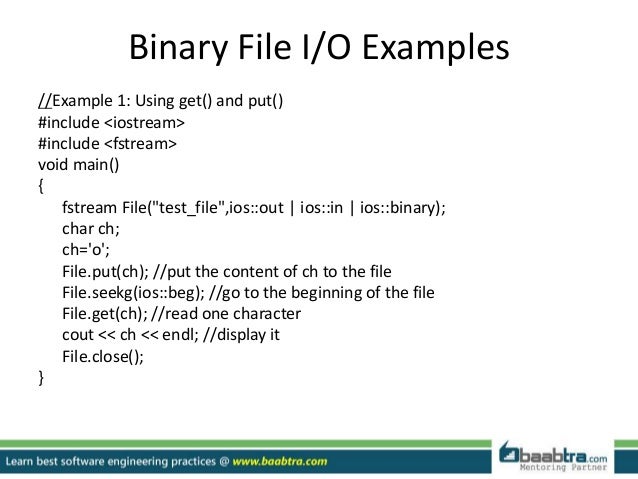
 All these flags can be combined using the bitwise operator OR. For example, if we want to open the file example. Each of the open member functions of classes ofstream, ifstream and fstream has a default mode that is used if the file is opened without a second argument classdefault mode parameterofstreamios outifstreamios infstreamios in ios out. For ifstream and ofstream classes, ios in and ios out are automatically and respectively assumed, even if a mode that does not include them is passed as second argument to the open member function the flags are combined. For fstream, the default value is only applied if the function is called without specifying any value for the mode parameter. If the function is called with any value in that parameter the default mode is overridden, not combined. File streams opened in binary mode perform input and output operations independently of any format considerations. Non binary files are known as text files, and some translations may occur due to formatting of some special characters like newline and carriage return characters. Since the first task that is performed on a file stream is generally to open a file, these three classes include a constructor that automatically calls the open member function and has the exact same parameters as this member. Therefore, we could also have declared the previous myfile object and conduct the same opening operation in our previous example by writing ofstream myfile example. Combining object construction and stream opening in a single statement. Both forms to open a file are valid and equivalent. To check if a file stream was successful opening a file, you can do it by calling to member isopen. This member function returns a bool value of true in the case that indeed the stream object is associated with an open file, or false otherwise if myfile. Closing a file. When we are finished with our input and output operations on a file we shall close it so that the operating system is notified and its resources become available again. For that, we call the streams member function close. This member function takes flushes the associated buffers and closes the file Once this member function is called, the stream object can be re used to open another file, and the file is available again to be opened by other processes. Standard Editing Text editing in SciTE works similarly to most Macintosh or Windows editors with the added feature of automatic syntax styling. Specify standards conformance mode to the compiler. Use this option to help you identify and fix conformance issues in your code, to make it both more correct and. In case that an object is destroyed while still associated with an open file, the destructor automatically calls the member function close. Text files. Text file streams are those where the ios binary flag is not included in their opening mode. These files are designed to store text and thus all values that are input or output fromto them can suffer some formatting transformations, which do not necessarily correspond to their literal binary value. Writing operations on text files are performed in the same way we operated with cout 1. This is a line. n. This is another line. Unable to open file. This is a line. This is another line. Reading from a file can also be performed in the same way that we did with cin 1. Unable to open file. This is a line. This is another line. This last example reads a text file and prints out its content on the screen. Good point if you have any. PDF files that contain the Visual Studio 2005 documentation. Various Support GDAL Raster Formats AAIGrid ArcInfo ASCII Grid. Supported for read and write access, including reading of an affine georeferencing transform and. Literally hundreds of companies now offer IoT platforms and IoT tools. Read this to help you pick the best platform for your needs. We have created a while loop that reads the file line by line, using getline. The value returned by getline is a reference to the stream object itself, which when evaluated as a boolean expression as in this while loop is true if the stream is ready for more operations, and false if either the end of the file has been reached or if some other error occurred. Checking state flags. The following member functions exist to check for specific states of a stream all of them return a bool value badReturns true if a reading or writing operation fails. For example, in the case that we try to write to a file that is not open for writing or if the device where we try to write has no space left. Returns true in the same cases as bad, but also in the case that a format error happens, like when an alphabetical character is extracted when we are trying to read an integer number. Returns true if a file open for reading has reached the end. It is the most generic state flag it returns false in the same cases in which calling any of the previous functions would return true. Note that good and bad are not exact opposites good checks more state flags at once. The member function clear can be used to reset the state flags. All io streams objects keep internally at least one internal position ifstream, like istream, keeps an internal get position with the location of the element to be read in the next input operation. Finally, fstream, keeps both, the get and the put position, like iostream. Cpp Read Binary Files' title='Cpp Read Binary Files' />These internal stream positions point to the locations within the stream where the next reading or writing operation is performed. These positions can be observed and modified using the following member functions tellg and tellp. These two member functions with no parameters return a value of the member type streampos, which is a type representing the current get position in the case of tellg or the put position in the case of tellp. These functions allow to change the location of the get and put positions. Both functions are overloaded with two different prototypes. The first form is. Using this prototype, the stream pointer is changed to the absolute position position counting from the beginning of the file. The type for this parameter is streampos, which is the same type as returned by functions tellg and tellp. The other form for these functions is. Various Supported GDAL Raster Formats. Supported for read and write access, including reading of an affine. This format is the ASCII interchange format for ArcInfo Grid. ASCII file, plus sometimes an associated. It is normally produced with the ArcInfo ASCIIGRID command. The projections support read if a. Additional sample. The NODATA value for the grid read is also preserved when available in the. By default, the datatype returned for AAIGRID datasets by GDAL is autodetected. Float. 32 for grid with floating point values or Int. This is. done by analysing the format of the NODATA value and, if needed, the data of the. From GDAL 1. 8. 0, you can explicitly specify the datatype by setting the. AAIGRIDDATATYPE configuration option Int. Float. 32 and Float. If pixels being written are not square the width and height of a pixel in. DX and DY parameters will be output instead. CELLSIZE. Such files can be used in Golden Surfer, but not most other. For force the X pixel size to be used as CELLSIZE. FORCECELLSIZEYES creation option or resample the input to have. When writing floating point values, the driver uses the. You can consult a. You can alternatively specify the number of decimal places with the DECIMALPRECISION creation. For example, DECIMALPRECISION3 will output numbers with 3 decimal. Starting with GDAL 1. SIGNIFICANTDIGITS3, which will output 3 significant digits using g format. The AIG driver is also available. ArcInfo Binary Grid format. NOTE Implemented as gdalfrmtsaaigridaaigriddataset. GDAL 1. 9. This is a convenience driver to read ACE2 DEMs. Those files contain. The georeferencing is entirely determined by the. Quality, source and confidence layers are of Int. Float. 32. ACE2 product overview. NOTE Implemented as gdalfrmtsrawace. Supported by GDAL for read access. Creation is possible, but it must be. GIS softwareAn ADRG dataset is made of several files. The file recognised by GDAL is the. General Information File. GEN. GDAL will also need the image file. IMG. where the actual data is. The Transmission Header File. THF can also be used as an input to GDAL. If the THF references more than one image. GDAL will report the images it is composed of as subdatasets. If the THF references just one image, GDAL will open it directly. Overviews, legends and insets are not used. Polar zones ARC zone 9 and 1. This is an alternative to using the OGDI Bridge for ADRG datasets. See also the ADRG specification MIL A 8. Supported by GDAL for read access. This format is the internal binary format for ArcInfo Grid. ArcInfo database. To open the coverage select the coverage directory, or an. If the directory does not contain files with names. Support includes reading of an affine. This driver is implemented based on a reverse engineering of the format. See. description for more details. The projections support read if a prj. Additional sample prj. NOTE Implemented as gdalfrmtsaigridaigdataset. Driver implementation for a raw format that is used in. Geo. Trellis and called ARG. Format is essentially a raw format, with a companion. JSON file. NOTE Implemented as gdalfrmtsargargdataset. BSB Nautical Chart format is supported for read access, including reading. GCPs. Note that the. BSB. files cannot be selected directly. Instead select the. KAP files. Versions. This driver should also support GEONOS format as supplied by Softchart. These files normally have the extension. This driver is based on work by Mike Higgins. See the frmtsbsbbsbread. BSB format. Starting with GDAL 1. BSBPALETTE configuration option. The default value is RGB. Other common values that can be found are DAY, DSK, NGT, NGR, GRY, PRC, PRG. NOTE Implemented as gdalfrmtsbsbbsbdataset. The. bt format is used for elevation data in the VTP software. The. driver includes support for reading and writing. Int. 16, Int. 32 and Float. The driver does. not support reading or writing gzipped. VTP software. Please unpack the files. GDAL using the gzip d file. Projections in external. Readwrite imagery access with the GDAL. This could. be corrected, but it would be a fair effort. NOTE Implemented as gdalfrmtsrawbtdataset. See Also The. BT file format is defined on the. VTP web site. This is a simple, read only reader for ceos image files. To use, select. the main imagery file. This driver reads only the image data, and does. This driver is known to work with CEOS data produced by Spot Image, but. In particular, it will. See the separate SARCEOS driver for access to. SAR CEOS data products. NOTE Implemented as gdalfrmtsceosceosdataset. GDAL 1. 9. This driver can read USGS Land Use and Land Cover LULC grids encoded in the. Character Composite Theme Grid CTG format. Each file is reported as a 6 band. Int. 32. The meaning of each band is the following one. Land Use and Land Cover Code. Political units Code. Census county subdivisions and SMSA tracts Code. Hydrologic units Code. Federal land ownership Code. State land ownership Code. Those files are typically named gridcell. USGS site. NOTE Implemented as gdalfrmtsctgctgdataset. GDAL 1. 1. Supported for writing and creation. The Direct. Draw Surface file format uses. Install Libflashplayer.So Ubuntu Chrome here. DDS, from Microsoft, is a standard for storing data. S3 Texture Compression S3. TC algorithm. The DDS. The driver supports the following texture formats DXT1. DXT1. A, DXT3 default and. DXT5. You can set the texture format using the creation option FORMAT. The driver supports the following compression quality SUPERFAST, FAST, NORMAL. BETTER and UBER. You can set the compression quality using the. QUALITY. More information about Crunch Lib. NOTE Implemented as gdalfrmtsddsddsdataset. This is a read only read for Spot DIMAP described images. To use, select. the METADATA. DIM file in a product directory, or the product directory. The imagery is in a distinct imagery file, often a TIFF file, but the. DIMAP dataset handles accessing that file, and attaches geolocation and. From GDAL 1. 6. 0, the content of the lt SpectralBandInfo node is reported as metadata. Note that the content of the SpectralBandInfo. NOTE Implemented as gdalfrmtsdimapdimapdataset. Support for read access to DODSOPe. NDAP servers. Pass the DODSOPe. NDAP URL to. the driver as you would when accessing a local file. The URL specifies the. In addition, you must. Latitude and Longitude. See the file README. DODS. for more detailed information. Support for read access, including reading of an affine georeferencing. This format is the old. DOQ Digital Ortho Quad format from the USGS. NOTE Implemented as gdalfrmtsrawdoq. Support for read access, including reading of an affine georeferencing. This format is the new. DOQ Digital Ortho Quad format from the USGS. This driver was implemented by Derrick J Brashear. NOTE Implemented as gdalfrmtsrawdoq. See Also. USGS DOQ StandardsGDAL 1. GDAL supports reading DEMsrasters exported as E0. Grids. The driver has been tested against datasets such as the one available on. NOTE Implemented as gdalfrmtse. GDAL supports reading and writing the ESRI. ESRI BIL format. Eight, sixteen. Coordinate systems from a. Unrecognized options in the. To. open a dataset select the file with the image file often with the extension. If present. clr color table files are read, but not written. If present. image. Spatio. Carte Defense 1. This driver does not always do well differentiating between floating point and. The GDAL extension to the. PIXELTYPE with values of either FLOAT, SIGNEDINT or UNSIGNEDINT.